Showing posts with label children. Show all posts

Wednesday, October 31, 2018

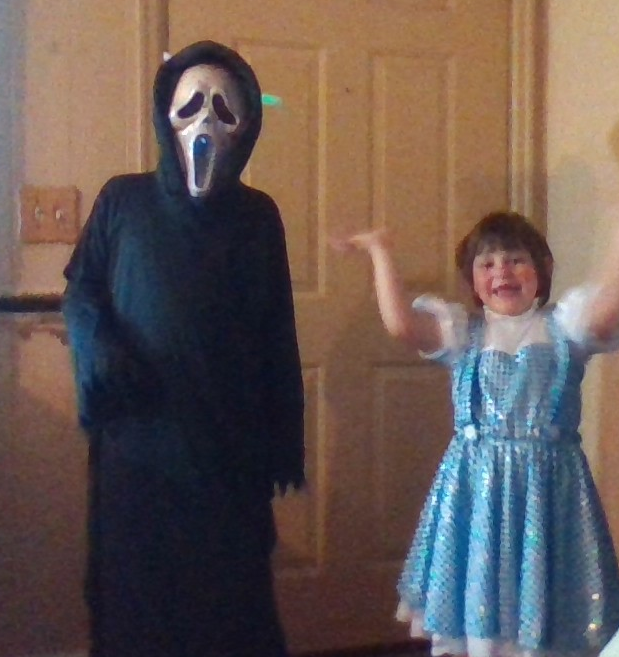
Samhain Night: a Night of the Sacred, a Night of the Profane

Samhain with younger kids is always a balance between the sacredness of the thinning of the veil and the profane (everyday or non-sacred) of dressing up in silly costumes to collect as much candy as possible. Neither is more or less important to the joy of the holiday.


That is a contradiction that I have learned to embrace. The kitschy, even materialistic, aspects of a Holy Day can be as spiritually and emotionally satisfying as any ritual in the heart of a child.

Combining the two will leave the spiritual forever entwined with costumes at Samhain, or (conscientious) gifting at Yule, or feasting at any of the Sabbats.

Isn't that what the goal really is? To make the spiritual so much a part of life that is a natural part of it?

That's what I'm hoping for. No matter if the kids stay Pagan throughout their lives, they will always feel that extra awe of the sacred in the midst of holiday minutiae. 

Tuesday, September 18, 2018

Pagan Parent Confessional: I Had PPD & No One Knew

Full disclosure: I didn't have adequate time or insurance coverage, so I was never diagnosed. This is my assessment of my own mental state after both of my pregnancies, with three years of pre-med college, two years of working in the medical field, and a healthy respect for the fallacies of self-diagnosis.

I plastered on a smile when I went to work every day. I spent most of the day ignoring my co-workers, skipping breaks, and seeing how many days in a row I could get away without speaking a single word to anyone. I maintained a strict daily schedule to be able to get to work on time, wash laundry, and occasionally get groceries.

Speaking of groceries - for nearly five years, there wasn't a single trip to the grocery store that didn't end with me crying in bed for an hour.

Symptoms of PPD


  • Anxiety - Like being either terrified or just numb every time I went out in public with my kid(s).
  • Depression - A complete lack of motivation to do anything 90% of the time. Habit was my only friend.
  • Mood swings - Crying jags, rage, fierce protectiveness.
  • Irritability - Oh, yeah. I broke up with my now hubby because I found out I was pregnant again.
  • Loss of interest - In people. In activities. In living.
  • Thoughts of harming self or the child - Let me be perfectly clear. The first year, for both kids, this was a DAILY thing. Every single day. Either I wanted to be dead, or I had thoughts of hurting my kid(s). Every. Single. Day.

But How Did I Hide It?

Oh, I'm good. See, I'm the ultimate altruist. When I decided to go through with my pregnancies, I formally accepted the obligation to see these children into adulthood to the best of my ability. I literally made an oath.

Because of that, my feelings on the matter didn't matter. I shut the emotions away and made a schedule to keep us going even when I could barely string two words together without sobbing, and that was that. Score one for dissociation.

Years of being an introvert stuck in customer service jobs taught me how to fake a real-looking smile. Compartmentalization allowed me to enjoy brief moments of interaction in the midst of nearly constant emotional self-abuse.

It probably also helped that my friends never visited and seldom called, so how would they know? My parents helped, but got frustrated, and I simply accepted what was offered, seldom even asking for more.

And I just plain didn't speak about my pain. To anyone. If I spoke to anyone at all.

How Did I Get Through It?

Well, one could argue that I didn't. I still have flashbacks and crying jags over this stuff, which is now close to 8 years gone. I can't talk about it without feeling guilty because 1) I chose to keep my kids, 2) I actually do love my kids, 3) I was never diagnosed, and 4) nothing bad actually happened.

Secondly, I reached out once, to one person, and he responded. After my second was born, I found myself struggling once more. And I realized I missed him. I talked to him online and looked for signs that he'd grown a bit - I really couldn't tell you if he had or if I'd just been hoping - and I offered to let him move in with me.

I have since been slowly working with the pain - shadow work, the never-ending cycle of shadow work. I occasionally find a new detail or depth that I'd missed. And it all comes up again.

Mostly, I just feel disappointed. I feel cheated about my pregnancies, about my birth experiences, about my kids' infancy. Like, I could have enjoyed all of them more, if only...

So What?

So... help new mothers. It doesn't have to be much. Visit for an afternoon. Take her a meal. Hold the baby while she showers. Call. Talk to her about her, not the baby. So many women feel like their identities are overwhelmed by their new role as baby's mom. Visit again.

Even a new mom who doesn't have PPD needs these connections. Someone to listen to them. Someone to help them remember themselves. Someone to care about them.

This is sacred work. This is caring for the newly born Mother. This is mourning the Maiden's passing. This is celebrating life cycles in all their dirty, messy, chaotic, natural state. This is community and priest/essing.

This is Paganism.

Thursday, June 21, 2018

Mother Goddess, Immigrant Children, and the Pain of Social Consciousness

All throughout my social media feeds, I am inundated. Children crying, screaming, for their parents. People begging not to be sent back to the country they fled to save their lives. And my own people - Pagans who feel the compassion of Oneness, of Gaia as Mother to All, yet cannot stop the wailing that we, the United States, has caused.

This is a tragic time for us, living through this time of horrific deeds shared worldwide, unedited, unfiltered, in an instant. We see all of the pain and joy of everyone, for the first time, getting a taste of how overwhelming it must be to have omniscience.

There is no way to describe this new way of living. It used to be that a small handful of photos, taken by a war correspondent, printed months after the fact, could shock us as a nation. Now, those photos are shared, meme'd and seen hundreds of times.

It is easy to become numb. It is easy to mute the videos and the audio recordings. It is all in our faces, and it is easy to push them away to protect ourselves.

What isn't easy is the realization that this choice could place us on the wrong side of history. What isn't easy is plowing through contradictions and lies to find the facts. What isn't easy is to open our hearts and hear what the gods are telling us. What isn't easy is to take a stand and to be vocal about it.

In truth, nothing about this is easy. But that's the point. Life isn't easy. It isn't supposed to be. Life is a mountain. You don't get to the top by complaining about the incline.

As a Heathen, I believe in certain values. First, in my heart is the value of Hosting, or Hospitality. It is my duty as a human on this earth to aide travelers, visitors, and those fleeing danger. It is my honor to provide for them, knowing that someday they or their children will do the same for another.

As a mother, I believe in a single rule: Always protect the children. This is non-negotiable, and I accept that others may need to be... um, removed to do this.

As a Pagan, a member of a minority religion, I believe that every right and generous action given to women, minorities, immigrants, etc. PROTECTS my rights. In a fascist situation, I will be one of the last to have my rights stripped. I will not let it get to me and my children. The rights of more vulnerable people literally protect my rights.

So there's some things to consider as we all struggle through this mess.

What are you doing about this situation? Are you good with your choice? Should you be?

Thursday, June 14, 2018

Pagan Children's Books Litha Newsletter

See the full Newsletter here.

It's time for Litha!

School is out! Our plans for the year are either in full swing or coming up soon! This time of year can be hectic and frustrating, and so much fun!

This would be a good time for kids and families to make some time to breathe. Camp and vacation is great, but are you stopping to enjoy everything along the way?

Don't be afraid to let things go, to say "no" to an activity, to just have a movie night instead of cramming another day-trip or public event in. And don't forget to check in with the rest of the family. Are they enjoying what's going on, or are they stressed from rushing around? Maybe they want more, maybe less.

Remember that the growth of your kids requires some down-time, even at this time of year.


There are some great activities you can do just for Litha. I'm pretty big on developing life skills, so I tend to focus on things that will help kids learn to take care of themselves later on.

Friday, April 27, 2018

Pagan Children's Books Beltaine Newsletter

View original HERE

The next Sabbat is just around the corner! Check out our thoughts on summer fun - tell us how you like it on our FB page!
Blessed be, <<First Name>>!

It is once again Beltaine in the northern hemisphere!

The school year is almost over, and the hot season will be upon us quickly. This is a great time to talk to kids about accomplishing their goals, and encouraging habits such as walking (instead of driving those few blocks), and recycling and neighborhood trash pick-up.

Parents, what values do you want your kids to really understand this year? What activities will help with that understanding? What small but mighty activities can you encourage?

Get your goals a-growing with some easy activities that keep your kids thinking and spotlight the values YOU want to instill!
ABC Book of Goddesses is a great choice for birthdays or bedtime reading!
The school year is almost over, but kids never stop learning. There are a few things that you can do over the summer to keep those young minds busy.

If you've been working with your kids on planting the seeds for their yearly goals, now is the time to put those into action!
  • Summer Camp. Whether it's a day camp or a week of overnights, camps can be a great way to immerse kids into an activity. There are music camps, sports camps, camping camps, and more. Check out what is in your area and talk about the options. Make sure you discuss budgets, too - those camps can get pricey!
  • Museums/Zoos. If you are fortunate enough to live in a place with a good museum or zoo, consider getting a membership. Kids can spend hours going through exhibits, and many museums and zoos have kids' areas where they can play and explore with only a little adult oversight. (Letting kids learn for themselves is a great way to foster their own interests AND build self-esteem!)
  • Scouting. Spiral scouts, girl scouts, or boy scouts (now open to girls, too) can be a great way to give kids a social outlet with goal-oriented rewards. Badges can cover all levels of ability and skill. It's well worth checking out.
  • Libraries. Consider having a library day - one day each week when you make a trip to the local book habitat. Spend some time browsing, check out story time, and take a few home to read throughout the week.
  • Nature walking the neighborhood. Challenge kids to find plants and animals throughout the neighborhood. Or go to a nearby park for your walks. Have a notebook handy to write down more interesting specimens, then see what videos and pictures you can find on the internet to expand your knowledge!

Saturday, October 14, 2017

Back to School Pagans: Minority Religions

I love the new school district we are in. Both my kid's are attending schools with a pretty huge variety of cultures, religions and ethnicities and races represented.

My son makes friends with kids from Iran. My daughter has friends who wear hijab. I've spoken to women who shared pictures of their daughters' human ceremony (it's a celebration marking a certain coming-of-age for the girls, similar to a bat mitzvah or First Communion). Both kids are sent home with papers in 3-7 different languages.

The interesting part, though, is that as a Pagan mom, I feel like I am more (painfully?)  aware of potentially stepping on religious toes. My son was making plans for his Muslim friend to join us for Pagan Pride in a year. I told him we needed to make sure his parents were okay with that first.
It seems that being a minority religion creates a kind of double-edged sword. Not only do we get to live in a culture that aggressively assumes we are Christian, but then we become so aware of how that hurts us, we go to extra lengths to not do that to others.

While this definitely makes us more empathic, we can find ourselves in some passive aggressive situations. A few that I end up in often:

  • Grandparents suggesting that any reluctance on my part for letting the kids do things through their church is an unfair judgment on them or their religion.
  • Family arguing that I'm at fault when I refuse to stay in communication with family members who use said communication to tell me I'm condemning my kids to Hell. 
  • People telling me that my religious choice means THEY won't get to spend eternity with me in Heaven... then crying about that.
  • People using the "what if you're wrong" logic, then giving me a blank look when I ask them the same question.
  • People acting like my choosing a religion that is bullied and discriminated against is somehow "easy", just rebellion, or about hurting them.

The point is, Paganism is hard. We are a minority. We are discriminated against. And, in many ways, it's getting both better and worse.
But I love that my kids are exposed to ideas that aren't just Christian or our immediate family. That's something to thank the gods for.

Saturday, June 10, 2017

Naming Children: Using Names and Zodiac to Balance Kids

When it came time to name my children, I had some thinking to do. There are so many things to consider, ways you can go. It can be overwhelming to try to find the perfect name for each kid.

I considered the "Pagan Name". You know, the pseudo-Native American, misspelled gemstones and nature stuff type of names that only Pagans and celebrities seem to ever consider: Storm Saffyre, Rayne Eagle, Apple Dumpling, Feenix Onyx, etc, etc.

I didn't go with that for many reasons. First, my kids would be going to public school, I knew that. I don't have the patience to home-school, and trying to do so would be detrimental to all of us. Whatever name I gave my child would have to survive 12 years of typical kiddo jerk-ness.

Second, my kids would be raised Pagan, but would they STAY Pagan? I don't know. I hope so, but I don't know. And giving them the equivalent of their magical name as their actual legal name... It felt like robbing them of some choice in the matter.

Third, my kids would be getting jobs around the age of 16 - and employers, for better or worse, judge applicants partially by their names. This is a fact. My act of rebelling against the naming status quo of society would very likely make it harder for my kids to find work and support themselves.

Next, I considered the "traditional" or family names. Typical, North American, Most-Popular-Names-in-History stuff. Names that my ancestors shared. Names like Edgar, Betty and 3.7 million names straight out of Christian myth: Jeremiah, Josiah, Peter, Paul, and Mary, etc.

Those seemed either way too common or way too old-fashioned for my tastes. After all, I was the one who would be screaming that child's full-name every five minutes while they rampaged their way through the grocery store. (No, that doesn't actually happen.)

Then I considered less traditional names. Ones that are relatively "a
cceptable" in mainstream society (aka, won't keep them from being CEOs and taking over the world for its own good), yet are a little edgy.

Perfect. But which ones?

I found a book (I don't recall the name, but I can point it out on a shelf) that talked about the meaning of sounds in your name. I looked up the sounds associated with my top choices in names. It was cool, but not something that really spoke to me.

Finally, I hit upon the kids' due dates. I knew around when they would be born, so I could guess at their likely sun signs.

The boy would be a Gemini, unless he was late... then he'd be a Cancer. Hmm, two signs that could use some serious grounding energy to balance them out. And my top name choice for the boy? A first and middle name that both meant types of land: a bog and a hill, if memory serves.

The girl was going to be a Taurus, no doubt. Because of the nature of the Bull sign, I decided that her weakest aspects would be in regards to finding and fulfilling her destiny. After all, Taurus loves to be comfortable, and destiny tends to push us out of our comfort zone. So she got a name that meant destiny or life path, with a surname of a goddess of grain (abundance, harvest, etc).

Do I regret how I chose my kids' names? EVERY DAY! :P

The boy (a Cancer) is both emotional and practical to an extreme. He is everything his name and sign should be, which means he tries to manipulate things to meet his desires. We call him Loophole Boy. He is so smart and keeps us on our toes. And while his emotions weren't necessarily mitigated by the power of his name, there is an influence there that seems to balance some of that out.

The girl, meanwhile, is domineering, a goddess in training and in her own mind. She knows what she wants from her life and she goes after it like a bull plowing through a brick wall. She's also a pretty, pretty princess and you better agree or she might attack. Keeping that girl in check is a full-time job, but I never have to worry that she will be a fad-follower. She doesn't cave to peer pressure; she IS the peer pressure.

How did you choose your kids' names? What do you like or dislike about my methods and reasons?

Tuesday, April 11, 2017

Summer Camps for Pagan Children: The Absence of Adventure

You would think that summer camps and Pagan children would go together like ice cream and waffle cones. Unfortunately, there is a serious gap in getting summer camps appropriate to Pagan children, particularly ones that are affordable.

Why? Well, because so many summer camps are sponsored by religious organizations. Pagan organizations tend to be sparse and/or ill-funded. Christians, however, have church groups in spades.

This means that affordable choices are often reduced to A) day camps for art or technology, B) 5-day or week-long camps for one sport or another, or C) 5-day or week-long summer camps that start and end each day with a prayer service.

Don't get me wrong. I don't begrudge other religions their beliefs, but I attended one of these camps with a "prayer service." We went horseback riding, swimming, canoing. We played Capture the Flag, and roasted marshmallows over a campfire. And nearly every single attendee was convinced to "accept Jesus into your heart" through individual prayer and counselling by the camp staff.

The point is, having a traditional camp experience, with a variety of outdoor activities, is incredibly difficult to find without the strings of (often Christian) religion attached. Attempts have been made to create Pagan-centered summer camps for kids but, so far as I can tell, they have all fallen away.

It might be worth it for us, as a community, to consider what the core issue is. Is the community just not family-oriented enough for kids' summer camps to be a priority? Is it that Pagans aren't supporting our spiritual organizations to the degree that such a sponsorship would happen?

Growing as a community means we need to start considering the needs of our future generations. We are seeing more and more Pagans raised in the Craft, and surely we will see even more in the future. Let's give those kids some memories and adventures, too.

Wednesday, March 29, 2017

Making Introductions: Teaching Our Children About Our Gods

"Who is this?" says the child, picking up the magnet of Kali from the fridge door.

"That's Kali," I respond. "She my favorite goddess."

"She looks scary."

"That's because she protects us from bad things. That's why she's a bit scary."

That was how I introduced my son to Kali, many years ago. He spent over a year entranced with the magnet showing Kali in all her deadly glory. When we moved, he insisted that we bring her along with us. Because she protects us.

Kids want to know about our gods and goddesses. They crave the security of having someone else looking out for them. They want to know that someone is looking out for mom and dad like mom and dad look out for them.

Here are some things to keep in mind when introducing the gods:


1.   Keep pictures and statues in sight and let the kids become curious about the images on their own. And they will. Kids are curious about everything.

2.   Don't be afraid to filter out some of the more complicated stuff - you can get to that later, when the child is older and better able to grasp those nuances.

3.   Keep the language age-appropriate. Just because a $5 word is commonly used doesn't mean that is the best way to describe the god or goddess to your child.

4.   Introducing the gods to our children doesn't have to be a full education. Our minds develop in such a way that we learn very well with small bits of information, stories and pictures. Tell a basic story or simple explanation of the god or goddess. Then, let the child have time to consider that. More questions will come.

5.   Involve the kids in basic rituals once they've been introduced. Our kids were intrigued about the candy we left out for Ganesha. Soon they were excited to help give the offerings (and later steal them - good thing Ganesha likes kids).

6.   Don't just limit the information to a textbook-type of description. Make sure that you explain why you like the god or goddess, and how they influence or help you. Show them the ways we interact with our gods and why we do it.

7.   When they are older, help your kids decide when and how to honor gods and goddesses for their own lives. Perhaps Thoth can help them study, or Apollo will inspire their choice of band instrument. Don't be afraid to make suggestions, but don't push them. Most kids will find the idea intriguing without any pressure.

Toddler Altar by MazerCreations
8.   Eventually, the child will ask about a god or goddess that isn't one of your bent. It may even be Jesus or Jehovah. It is important to remain objective about them. If you aren't critical about any other gods, they will notice if you are critical about that one. Explain who the god or goddess is, why some people choose to worship them, and why you choose not to. It's okay to go into social and historical contexts, as long as it's age-appropriate.

9.   Have fun! Gods and goddesses are for celebrating. Let your child feel your own emotional connection to the gods, and let them get excited to share that.

10.  Don't worry about brainwashing. It's a lot harder to brainwash people than you think. For children, this is a comfort and a family bond. If you don't think they will ever be able to choose for themselves... well, wait 'til they're teens.

Monday, March 20, 2017

Children & Beliefs: Teaching our kids our practices

Pooka Pages
Illustration from Pooka Pages
Why we should teach our kids our religion while we raise them? Why it is so important to embrace sharing our beliefs with our children? How to do so without forcing them or making them feel trapped by their parents' beliefs?

These are questions that the Pagan community struggles with as we raise our children in the highest numbers since Gardner published Witchcraft Today in 1954.

We are so used to seeing the effects of religious belief being framed in Christian terms. That is the world we live in.

But what does pure religious belief have to offer our kids? There are studies (here, here, here, and here) that indicate that sharing religious beliefs, activities and experiences can strengthen a family's relationships to each other. There is often more connection and communication.

Children standing with The Lady of Cornwall
in a neopagan ceremony in England.
Religious beliefs may help children better deal with the natural stresses of life by providing a sense of belonging to a group and being part of "something bigger". The routine of rituals and holidays can provide a sense of structure to a child's life.

Healthy spiritual beliefs may improve health, both physical and psychological. Religion provides a way to express the innate need to find purpose and reason in the natural world, and a way to express our beliefs in a supernatural world.

Obviously, these benefits are only seen when the religious experience is a positive one. When the religious experience is confining, restrictive or even hostile, the affects of religion can turn very dark.
Some ways that teaching religion does NOT support healthy religious beliefs include:

  • punishment for not adhering to religious behaviors
  • teaching by rote memorization rather than engaging with stories and games
  • negative reactions to questioning the religious teachings – this can include refusal to answer or refusal to consider alternatives
  • using fear as a way to reinforce belief – ie, if you don’t believe, you’ll go to hell

Leaving kids the choice is an issue that I hear a lot of. So I ask, how does allowing your children to religiously identify the same way that their mom and dad do, close the door to them asking about other religions? Or prevent them from later changing their mind?
From Raising Pagan Children

If we want our children to feel like a complete part of our families, we need to include them in our religious experiences. We can do this by talking to our kids about our beliefs, about the rituals that we practice, and about the gods and spirits that we interact with in our lives.

I will leave you with a quote from an article from UU World: “Sharing personal religious and spiritual beliefs with children is not indoctrination; it is offering the guidance they eagerly seek until they are developmentally ready to decide for themselves. If children receive vague and confusing answers time and again when they ask about spiritual and theological issues, they’ll eventually stop asking and start looking for answers elsewhere. But many of the other people your children may encounter in life will not be so hesitant to pass on their religious beliefs, opening up the possibility that the vacuum you’ve left will be filled by others who are seeking to indoctrinate them.”

Sunday, January 22, 2017

Books for Pagan Children: Teens (T-Y)

It can be difficult to find books for your Pagan children to read. You want books that teach them your values, and maybe something close to your beliefs and traditions.

I have compiled a list of good books by great authors. Many are outright Pagan. Some are Pagan in flavor or Pagan-friendly. I am noting when the author is Pagan to encourage support of Pagan authors and artists.

Previous


  • Teen Witch: Wicca for a New Generation by Silver RavenWolf (Non-Fiction) *PAGAN*
    What Teen Witch will show you is that how you live, how you deal with others, and how you incorporate Wiccan laws into your life determines whether or not you are a true Witch. This handbook presents everything from the Wiccan principles of belief, traditions, symbols, holidays and rituals, to spells for homework and dating.

  • Witch Among Wolves, A by Rebecca Buchanan (Fiction) *PAGAN*
    The Pagans of the contemporary world, in addition to rediscovering the Gods and heroes of old, are also writing for those Gods and heroes. "Alexander's Heart" is a science fiction tale set in a distant future ruled by the descendants of Cleopatra and Marc Antony. "Devourer" finds the Egyptian Goddess Bast in modern-day Louisiana, while "The Flower in the Dark" addresses political oppression and liberty. "Footprints" follows the Olympian Queen of the Gods to contemporary Florida, while "Orion: An EcoFable" explores the nature of environmental responsibility and the consequences of human arrogance. Finally, "A Witch Among Wolves" centers around a Lithuanian ragana, a devotee of the Horned Lord of the Underworld.

  • Yule: A Celebration of Light and Warmth by Dorothy Morrison (Non-Fiction) *PAGAN*
    In the pages of Yule, Dorothy Morrison presents a wonderful potpourri of holiday lore from around the world and throughout history, along with fun crafts, delicious recipe seven a calendar of celebrations for every day in December.

Sunday, January 15, 2017

Books for Pagan Children: Teens (M-S)

It can be difficult to find books for your Pagan children to read. You want books that teach them your values, and maybe something close to your beliefs and traditions.

I have compiled a list of good books by great authors. Many are outright Pagan. Some are Pagan in flavor or Pagan-friendly. I am noting when the author is Pagan to encourage support of Pagan authors and artists.

Previous


  • Mabon: Celebrating the Autumn Equinox by Kristin Madden (Non-Fiction)
    This book explores the history, legends, and traditions of the season that is honored from the Far East to the Celtic Lands, and from Scandinavia to South America. Create your own Mabon tradition with the help of the book's many recipes, magical workings, equinox rituals, and crafts for all ages.

  • Mi's Search for Beauty by Kyrja (Fantasy) *PAGAN*
    In a time and land when death is regarded as the “Realms Beyond,” where surviving children are expected to offer their prayers and services so their ancestors may reach the “Golden Realm of Light,” spirits are known to cause havoc for their own means. Sooshay and Keylei, both disdainful of the stifling moors of their traditional culture have forgotten this lesson, so are caught painfully unaware when their sixth daughter, Mi, is born. Five daughters were foretold; no more and no less, with no sons. The terrifying changes this sixth daughter unwittingly brings with her touches each member of her family. Ignorant of his own role in the chaos that follows, Sooshay seeks the advice of a mysterious old family friend, placing Mi and all of her sisters in danger.

  • Midsummer: Magical Celebrations of the Summer Solstice by Anna Franklin (Non-Fiction)
    Midsummer is one of the most ancient, widespread, and joyful Pagan festivals. The sun rises to the height of its power on the summer solstice, and Midsummer Eve is filled with fairy mischief and magic. Anna Franklin reveals the origins and customs of this enchanting holiday.

  • Ostara: Customs, Spells & Rituals for the Rites of Spring by Edain McCoy (Non-Fiction) *PAGAN*
    Embrace Ostara as a point of balance in your life, a moment in time where both dark and light and night and day are in harmony before the light is victorious and carries us on to the bounty of summer pleasures. Ostara is packed with rituals, spells, recipes, crafts, and customs to celebrate the awakening earth.

  • Price of Beauty, The by Kyrja (Fantasy) *PAGAN*
    Majo had been the Gatekeeper for more than 700 years, guiding souls into the Realms Beyond and keeping the demons from the land of the living, before tricking the young Mi into taking her place. Eager to earn entry into the Golden Realm of Light, five spirits of Mi’s long-dead ancestors had aided Majo in manipulating each of her sisters in turning her into a freak. Majo’s plan went awry, though, when the sisters used the terrible gifts of their ancestors’ power to transform Mi, but left her with a narrow way in which she might redeem herself.


  • Serpent in the Throat, and Other Pagan Tales, The by Rebecca Buchanan (Fiction) *PAGAN*
    This anthology - the second following A Witch Among Wolves, and Other Pagan Tales - continues the tradition of Pagan authors writing Pagan tales for a Pagan audience. "Black Leopard" is a contemporary magical realism tale centering on Dionysus, while "Crossroads" finds a young girl voicing a heartfelt prayer to Hekate. "Hysthaany" follows a small community of Sekhmet devotees into outer space on a mission of mercy, while "Mr. West" finds Osiris paying a visit to a modern-day mortician. "Seeds" is set in a dystopian future of environmental degradation, while the title story, "The Serpent in the Throat," is an adventure-horror tale set in ancient Canaan.

  • Sister Light, Sister Dark by Jane Yolen (Fantasy)
    Legend foretold the child named Jenna, who was three-times orphaned before she could crawl, a fate that would leave her in the hands of women who worshipped the benevolent goddess Great Alta. In this world without men, Jenna comes of age, learning quickly the skills of close combat. But her most powerful gift lies elsewhere: a mirror sister who emerges only in the darkness—a twin named Skada—and shares the soul of the young, white-haired warrior who might well be the goddess reborn. But if Jenna is, in truth, the one whose coming is awaited, there is cause for great alarm among those who rule the Dales, for the prophecy speaks of upheaval and change, and a devastating end of all things.

  • SpellCraft for Teens: A Magickal Guide to Writing & Casting Spells by Gwinevere Rain (Non-Fiction)
    Empower, bewitch, and enchant. Written by a teen witch with her own popular website, SpellCraft for Teens contains fifty-five chants and incantations. In addition, it provides a twelve-step guide to casting a magick circle, an in-depth look at the moon phases, and the magical properties of colors, herbs, and charms. From finding a craft name to performing the three types of love spells, SpellCraft for Teensaddresses issues specific to young adults, including telling parents about their interest in Wicca and dealing with gossiping classmates.


Sunday, January 8, 2017

Books for Pagan Children: Teens (H-L)

It can be difficult to find books for your Pagan children to read. You want books that teach them your values, and maybe something close to your beliefs and traditions.

I have compiled a list of good books by great authors. Many are outright Pagan. Some are Pagan in flavor or Pagan-friendly. I am noting when the author is Pagan to encourage support of Pagan authors and artists.

Previous


  • Gatekeeper'sSon, The by Kyrja (Fantasy) *PAGAN*
    Delivered stillborn, Sooshay-Chan was unexpectedly brought back to life when his mother, Mi, summoned the previous Gatekeeper, Kazuko, to formally accept her role as Guardian of the Gateway. Because he demonstrates knowledge and skills no child should possess, his family suspects the boy has been reborn with the soul of his grandfather. Mi is the only one who knows that her father’s spirit has traded places with the spirit of her unborn son in the Realms Beyond. When warned by her sister named for the virtue of Justice that she must send her father’s spirit back, or the ancient Goddess of Death will escape into the realm of living, she is torn. Never before has a Guardian had a living child; Sooshay-Chan is unique in all the history of the land. How can she save her son without destroying the world?

  • Halloween! by Silver RavenWolf  (Non-Fiction) *PAGAN*
    Just where did the autumn gaiety begin? Let Silver RavenWolf guide you through the cobwebby corners of time to uncover the history behind Halloween. Honor the spirit of this hallowed harvest holiday.


  • Juniper by Monica Furlong (Fantasy)
    Though Juniper enjoys the easy life of a medieval princess, she chooses to learn about herbs, healing, and the magic within nature from her strange and difficult godmother. As her training comes to an end, Juniper discovers that her power-hungry aunt is using black magic to seize the throne. Juniper must use her as-yet-untested powers to stop her—before the kingdom is destroyed!

  • Lammas: Celebrating the Fruits of the First Harvest by Anna Franklin (Non-Fiction) *PAGAN*
    Once a prominent Celtic festival known as Lughnasa (from the Gaelic nĂ¡sad, games or assembly, ofLugh, a Celtic deity and hero), Lammas is a joyful celebration of the first harvest. In an age when crops can be imported all year round, we tend to forget just how important this time was to our ancestors―the failure of the harvest meant starvation and death. Early August was a time to celebrate the fruits of the first harvest and work positive magic for prosperity and protection.

  • Llewellyn's Witch's Coloring Book by Mickie Mueller (Activity) *PAGAN*
    Brighten your days with the magic of color! Featuring the expressive artwork of six popular Llewellyn artists, this coloring book will take you to an enchanted realm of reverie and quiet pleasure. Includes more than 60 colorable pictures of witch's potions, ancient rituals, magical symbols, and more. Each page has perforated edges for easy removal and is suitable for display in a standard frame.